A BRIEF HISTORY OF THE FRATERNAL ORDER OF POLICE
In 1915, the life of a policeman was bleak. In many communities they were forced to work 12 hour days, 365 days a year. Police officers didn't like it, but there was little they could do to change their working conditions. There were no organizations to make their voices heard; no other means to make their grievances known.
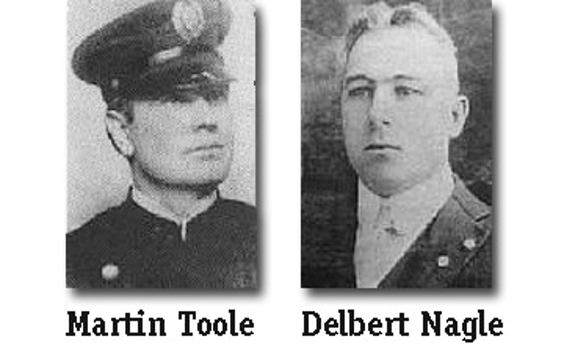
This soon changed, thanks to the courage and wisdom of two Pittsburgh patrol officers. Martin O'Toole and Delbert Nagle knew they must first organize police officers, like other labor interests, if they were to be successful in making life better for themselves and their fellow police officers. They and 21 others "who were willing to take a chance" met on May 14, 1915, and held the first meeting of the Fraternal Order of Police. They formed Fort Pitt Lodge #1. They decided on this name due to the anti-union sentiment of the time. However, there was no mistaking their intentions. As they told their city mayor, Joe Armstrong, the FOP would be the means "to bring our aggrievances before the Mayor or Council and have many things adjusted that we are unable to present in any other way...we could get many things through our legislature that our Council will not, or cannot give us."
And so it began, a tradition of police officers representing police officers. The Fraternal Order of Police was given life by two dedicated police officers determined to better their profession and those who choose to protect and serve our communities, our states, and our country. It was not long afterward that Mayor Armstrong was congratulating the Fraternal Order of Police for their "strong influence in the legislatures in various states,...their considerate and charitable efforts" on behalf of the officers in need and for the FOP's "efforts at increasing the public confidence toward the police to the benefit of the peace, as well as the public."
From that small beginning, the Fraternal Order of Police began growing steadily. In 1917, the idea of a National Organization of Police Officers came about. Today, the tradition that was first envisioned over 100 years ago lives on with more than 2,100 local lodges and more than 382,000 members in the United States. The Fraternal Order of Police has become the oldest and largest professional law enforcement organization in the country. The FOP continues to grow because we have been true to the tradition and have continued to build on it. The Fraternal Order of Police are professionals working on behalf of law enforcement officers from all ranks and levels of government.
Credit to Fort Pitt Lodge No. 1 for the above information.
LEBANON LODGE NO. 42 HISTORY
Special Thanks to Lodge Historian, Brother Derek Underkoffler, for locating the below information which was listed in the LEBANON DAILY NEWS, on Saturday, May 22, 1926.
The Daily News (Lebanon, Pennsylvania) · Sat, May 22, 1926 · Page 1
LEBANON LODGE OF FRATERNAL ORDER POLICE - Was Organized by members of the Reading Lodge - On Friday night - Purpose is to promote good fellowship among Officers
Lebanon Lodge, No. 42, Fraternal Order of Police, was organized at City Hall, on Friday evening, by representatives of that organization from Reading. The meeting, which was attended by members of the local police force, was held in the room to the rear of the Council Chambers. Great enthusiasm marked
The Daily News (Lebanon, Pennsylvania) · Sat, May 22, 1926 · Page 9
the first meeting of this lodge, which is the first organization of its kind to be formed in the city of Lebanon.
Purposes of the organization are to produce a greater spirit and friendliness among the members of the police force, and with policemen of other cities. The F.O.P. is especially strong in Pennsylvania, New York, New Jersey, and other Eastern states. It is expected that the police force will join 100 percent before many days have passed. Several were not present on Friday evening because of other matters which claimed their attention.
Herman Anspach, familiarly known as "Carty" motor policeman, was elected president of the Lebanon Lodge. Other officers elected were: Robert McCullogh, vice president; Henry Bours, recording secretary; Harry Sealer, financial secretary; Claude Weidler, treasurer; Harry Eichelberger, Harvey Smith and Harry Sattazahn, trustees.
A charter was granted to the company, and all members took the required oath. Meetings will be held regularly once a month. A definite time has not been selected as yet. The organization also provides for sick and death benefits.
Those who motored from Reading to effect the organization were: Sergeant Arthur Larkin, financial secretary, F.O.P., George W. Bierman, recording secretary, F.O.P., Madson Dengler, patrolman, and Clarence bates, a former resident of this city.
Local members of the organization are: Harry Sealer, Chief of Police; Ed J. McLaughlin, sergeant; Henry Bours, sergeant; John P. Reed, traffic officers; Herman Anspach, motorcycle officer; Harry Eichelberger traffic officer; Claude Weidler, patrolman; Wilson Cooper, patrolman; Harvey Smith, patrolman; Austin Sando, patrolman; Robert McCullough, patrolman; and Delbert Zimmerman, motorcycle officer.
The F.O.P. also accepts "Booster members"; that is local businessmen or other persons who are interested in the welfare of the police department. R. Ray Miller, of Miller's store, was the first booster member. It is expected that several others will join in the near future.
Reading representatives congratulated the Lebanon policemen upon their enthusiasm and expressed the belief that Lebanon Lodge will be an asset to the F.O.P.
Click on the images below to view a PDF of the article.


